



September in Boca Raton means dew points in the mid-70s, a thunderstorm most afternoons, and the habit of checking the tropics before you check the forecast. It’s brutal on a stored 1967 Mustang or a 1972 911 under a cover in a closed garage. The air never moves, and moisture condenses on cold metal every night.
Humidity does the slow damage. Batteries do the fast kind. AAA notes that a typical car battery lasts three to five years, and heat shortens that span, so a battery left to self-discharge through a hot Florida summer often doesn’t come back at all.
Quick Summary: Key Takeaways
- Target 45 to 55 percent humidity: A garage dehumidifier set to 50 percent beats any car cover.
- Fill the tank, then stabilize it: E10 pump gas pulls water out of humid air, and a nearly full tank leaves less room for condensation.
- Use a breathable cotton cover: Plastic tarps trap moisture against paint and chrome and cause the rust they’re meant to prevent.
- Air tires to 40 psi: Higher storage pressure limits the flat spotting that bias-ply and older radial tires take on.
- Write the storm plan first: Atlantic hurricane season peaks around September 10, so settle now who moves the car, where it goes, and whether the building sits in a flood zone.
Florida humidity attacks a stored car from three directions at once
Moisture, not time, is what ruins stored cars here. Condensation forms on bare metal every night the garage cools faster than the air inside it, and that means brake rotors, chrome bumpers, exposed bolt heads and the inside of the exhaust. Interiors get it worse.
Mohair, wool and untreated leather in a 1960s cabin hold water, and mold takes a headliner in about two weeks at 80 percent relative humidity. Water also collects in the fuel system, the crankcase and the differential vent. All of it invisible until you open something.
Ethanol fuel is the biggest single risk in a carbureted classic
E10 pump gas is hygroscopic, which is a technical way of saying it drinks water out of humid air. Leave it six months and the water separates out, settling at the bottom of the tank right where the pickup is. That’s phase separation. It corrodes steel tanks, plugs jets, and eats the rubber in older fuel lines and accelerator pumps.
Buy ethanol-free fuel. Marinas around Palm Beach County sell it, and so do a handful of stations out in West Boca. Fill the tank to about 95 percent, add a stabilizer rated for ethanol, and run the engine long enough to get treated fuel into the carburetor bowls. Then park it.
Batteries, brakes and tires fail in storage in predictable ways
A battery left connected loses charge to parasitic draw and sulfates, and Florida heat speeds that up until the plates simply won’t take a charge anymore. Pull it or plug it in. A float-mode maintainer holding around 13.2 volts prevents it for the cost of a tank of gas.
Brake rotors surface-rust in weeks, then the pads bond to them. Tires flat-spot, and old bias-ply rubber takes a set that doesn’t roll out. Rodents are the fourth one. A wiring harness on a 1970s British car is a buffet, and mothballs won’t stop them.
In hurricane season the storage location matters more than the cover
Storage location matters from June 1 through November 30. The Atlantic season peaks around September 10, and a garage that’s fine in February may sit in a surge or flood zone when a named storm lines up on Palm Beach County. Saltwater intrusion ends a classic car. Not damages. Ends.
Write the plan before the cone shows up on the news. Who moves the car, where it goes, how many hours of warning you actually need. Inland, elevated, away from trees, and off any floor that has ever been wet.
How a Boca Raton shop checks a classic before it goes under a cover
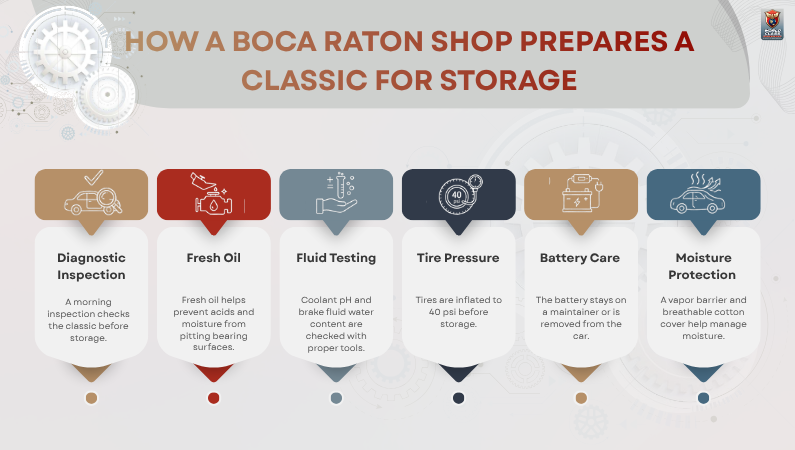
A diagnostic inspection takes a morning and heads off most of the list above. Fresh oil goes in first, because used oil carries acids and moisture that pit bearing surfaces over months of sitting. Coolant gets a pH test, and brake fluid gets checked for water content with a meter rather than by eye. Guessing doesn’t count.
Tires up to 40 psi. Battery on a maintainer or out of the car entirely. A vapor barrier under the car on a concrete slab stops slab moisture from feeding the humidity inside your cover, and breathable cotton lets whatever is already there evaporate.
Four restoration bays on Glades Road, and storage advice built for Boca Raton
Classic work here means 1975 and older, in four dedicated bays. Different discipline. That’s why the storage advice we give is specific to Boca Raton and the dew points that come with it, rather than copied from a magazine written in Ohio.
A car stored in a dry Midwestern garage needs almost none of what a car stored two miles from the Atlantic needs, and that Ohio article will never mention salt air, phase separation timelines, or September flood maps. We’re on Glades Road at 9787, open Saturdays until 3, and a diagnostic inspection before the cover goes on is the appointment that saves money.
Frequently Asked Questions
Q: How do you store a classic car in Florida humidity?
A: Hold the garage between 45 and 55 percent relative humidity with a dehumidifier, use a breathable cotton cover, fill and stabilize the fuel, and keep the battery on a float maintainer.
Q: Should I run my classic car while it’s in storage?
A: Drive it fifteen minutes once a month rather than idling it in the driveway. Idling won’t do. It never gets the oil and exhaust hot enough to burn off the moisture that causes the damage.
Q: Does ethanol fuel go bad in a stored car?
A: E10 absorbs water and can phase-separate in as little as three to six months in a humid garage. Ethanol-free fuel plus a stabilizer is the safer combination for a carbureted car.
Q: What tire pressure should I use for long-term car storage?
A: About 40 psi, higher than your normal driving pressure. It reduces the flat spot that forms where the tire sits, which matters most on older bias-ply tires.
Have your classic checked before it goes under the cover
A diagnostic inspection catches the fluid, fuel and battery problems that turn into a spring restoration bill. It takes one morning. Boca Raton, Delray Beach and West Boca owners are all a short drive out.
Hours: Mon-Fri 7:30 AM – 5:30 PM, Sat 8:00 AM – 3:00 PM, Sun closed
Website: worldclassautorepaircenter.com