


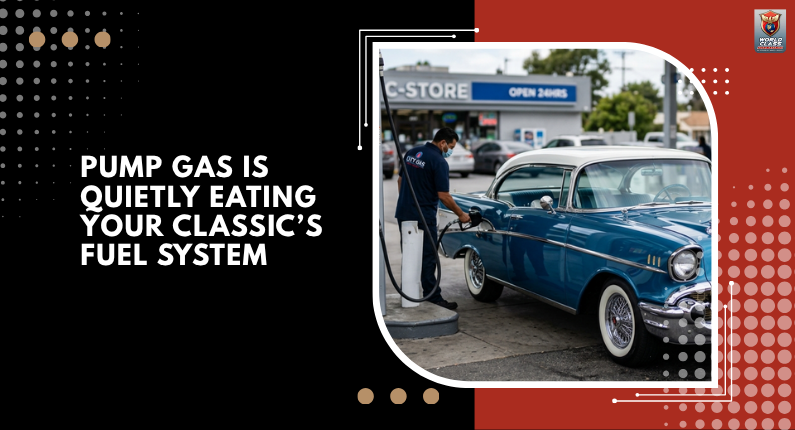
The car started fine in May. Now it cranks for ten seconds, idles rich, dies at the first stop sign, and there is a smell of gasoline in the garage that was not there in the spring. Nothing broke. The fuel just did what modern fuel does to a system designed in 1971.
This is the most common thing we find on a classic that has sat through a South Florida summer. World Class Auto Repairs on Glades Road handles European, exotic and classic-car restoration work, and the fuel system is where the summer bill almost always lands. Boca Raton‘s driving season is opening now, and a fuel smell in a closed garage is not something to put on next month’s list.
Quick Summary: Key Takeaways
- Ethanol attacks pre-1990 rubber: original fuel hose swells, softens and eventually weeps, and a weeping line over a hot exhaust manifold is a fire.
- It also carries water: ethanol absorbs moisture, and in Florida humidity a half-full tank ends up with water at the bottom.
- Phase separation is the real damage: once water and ethanol drop out of the gasoline, that layer sits on the tank floor and corrodes everything it touches.
- Carburetors and sending units suffer: varnish blocks jets and passages, and corrosion attacks the zinc and aluminum castings.
- Driving the car is the best preservative: a classic used every couple of weeks has far fewer fuel problems than one started twice a year.
What E10 does to the fuel system in a 1975-or-older car
Ethanol is a solvent and a drying agent, and neither is good news for a car designed around leaded gasoline. It softens and swells the nitrile rubber used in older fuel hose, dissolves decades of varnish off the inside of a tank, and holds water in suspension in a way straight gasoline never did.
This is not a fringe fuel. EIA reports that fuel ethanol has made up more than 10 percent of total U.S. motor gasoline consumption every year since 2017, which means the pump you use is E10 unless you have gone looking for something else.
Newer cars were built for it. Yours was not.
Florida humidity turns a half-full tank into a water trap
Every tank breathes. Air goes in as fuel is used and as the tank heats and cools, and in Palm Beach County that air is carrying a great deal of moisture with it — all summer, every day, into whatever airspace is left above the fuel.
Ethanol holds that water until it cannot. Past a certain point the water and ethanol separate out of the gasoline and settle to the bottom of the tank as a corrosive layer, which is where the pickup sits and where the sending unit lives, and the gasoline left floating above it has lost the octane the ethanol was providing.
That is why a car that ran perfectly in spring runs badly in autumn with nobody touching it. Store them full, and keep the fuel fresh — a classic driven every other weekend does not develop this problem.
The parts that fail, roughly in order
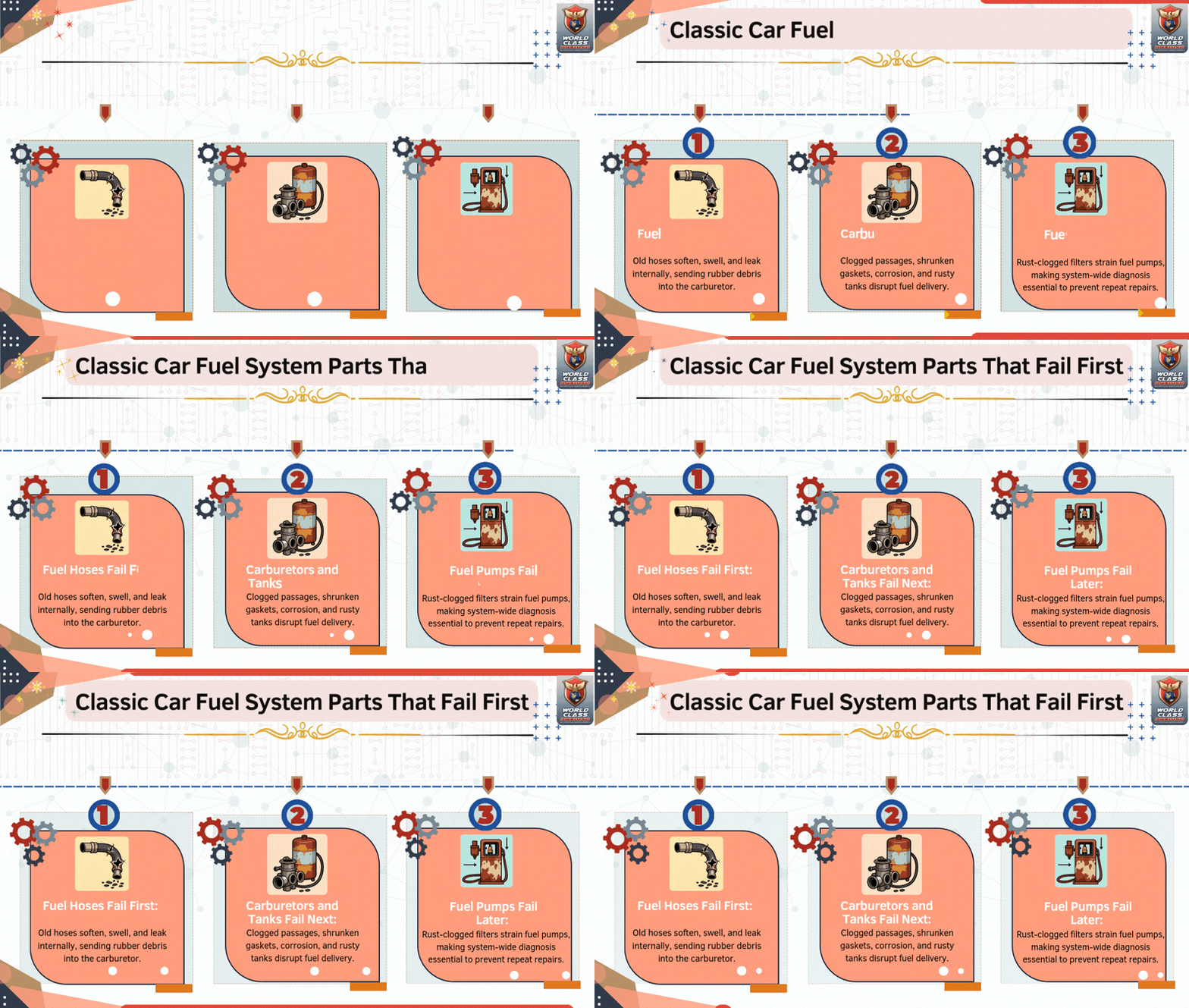
Rubber first. Original fuel hose from the 1960s and 1970s gets soft, swells at the clamps, and starts seeping at the ends long before it splits — and it fails from the inside, so a line that looks fine on the outside can be shedding rubber into the carburetor.
Then the carburettor. Varnish plugs the idle circuit and the small passages first, cork float-bowl gaskets shrink, needle-and-seat assemblies stick, and the zinc and aluminium castings corrode where water has been standing. Steel tanks rust from the bottom up and sending units stop reading.
Fuel pumps go last, usually after a year of pulling fuel through a filter full of rust flakes. It is one system, and diagnosing one piece in isolation is how people replace a carburettor twice.
The symptoms worth stopping for, and the one worth stopping immediately
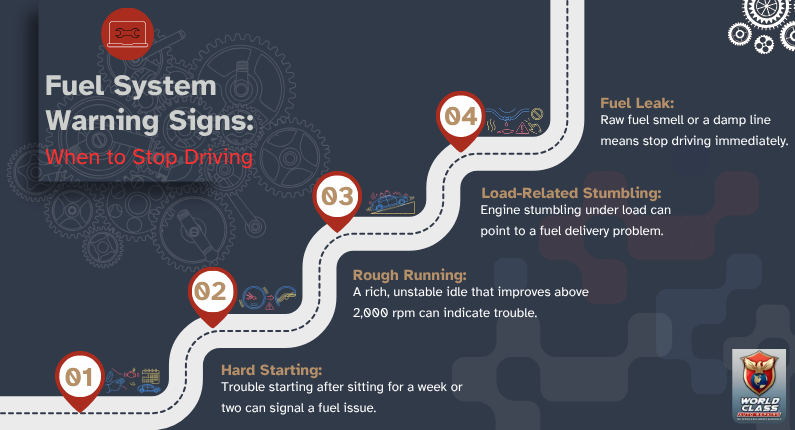
Hard starting after the car has sat a week or two. A rich, unstable idle that cleans up above 2,000 rpm. Stumbling under load on the causeway. A fuel filter gone brown, or visible sediment when you drain the bowl.
One symptom is not a maintenance item. If you smell raw fuel in the garage or find a damp spot on a line or clamp, stop driving the car — a leak near a hot manifold is exactly how these cars burn, and it is the one thing here we will not tell you to keep an eye on.
What gets changed when a classic comes back out for the dry season
The order matters. There is no point rebuilding a carburettor while the tank is still feeding it rust, so the work starts at the back of the car and moves forward: the tank and what is sitting in it, then the lines, the filter, the fuel delivery, and the carburettor last.
Battery and charging deserve a look in the same visit, because a classic that sat through hurricane season has been sitting on a discharged battery, and a slow crank makes every fuel problem look worse than it is.
Boca Raton’s driving season starts as soon as the heat breaks
This is the good stretch. From now through May the humidity backs off, the cars come out, and the shows and morning drives fill the calendar — a much better reason to sort the fuel system than a tow truck on Glades Road.
We are at 9787 Glades Road, and the shop works on everything from air-cooled 911s to American iron to the modern European cars in the next bay. Our honest advice for any classic in this climate: drive it more often, keep the tank full, and have the fuel system inspected once a year.
Frequently Asked Questions
Q: Is ethanol gas bad for classic cars?
A: For the fuel system in a 1975-or-older car, yes. Ethanol swells and softens older rubber hose, dissolves varnish inside the tank, and absorbs water that eventually separates out and corrodes metal parts. The car runs on it; the fuel system pays for it.
Q: How do I protect a classic car fuel system from ethanol?
A: Replace the rubber lines with hose rated for current pump gas, store the car with a full tank, keep the fuel fresh by driving it regularly, and have the tank, filter and carburettor inspected once a year.
Q: What is phase separation in gasoline?
A: It is what happens when ethanol has absorbed more water than it can hold. Water and ethanol drop out of the gasoline and settle to the bottom of the tank as a corrosive layer, right where the fuel pickup sits.
Q: Why does my classic car run rough after sitting all summer?
A: Usually stale fuel plus what the stale fuel did to the system. Varnish in the carburettor’s small passages, water at the bottom of the tank and a restricted filter show up as hard starting, a rich idle and stumbling under load.
Get the fuel system inspected before the first show weekend
Bring the car to Glades Road and we will look at the tank, lines, filter and fuel delivery as one system, then tell you what has to be done now.
World Class Auto Repairs — 9787 Glades Rd, Boca Raton, FL 33434
Hours: Mon-Fri 7:30 AM-5:30 PM; Sat 8:00 AM-3:00 PM; Sun closed
Website: worldclassautorepaircenter.com