


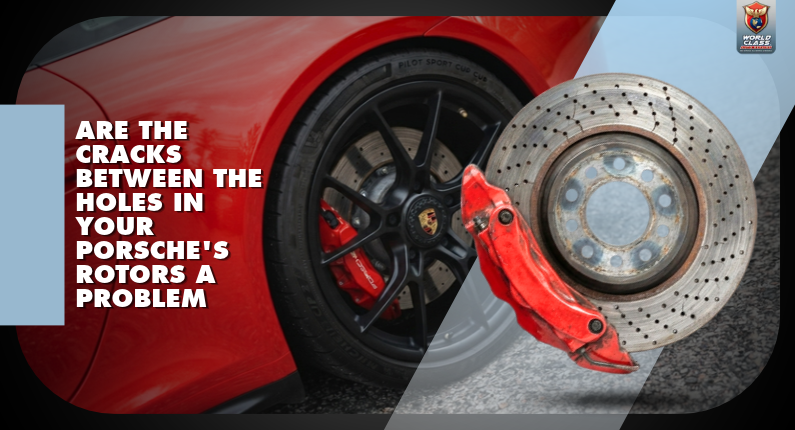
Owners ask us that in the Boca Raton lobby with a phone photo already open. Somebody at a detailer or a tire shop looked through the wheel spokes, saw fine lines running between the drilled holes, and said the rotors were cracked and dangerous. Sometimes that is right and the rotor is finished. Often it is a normal surface feature of a cast drilled rotor and the car has thousands of miles left. The difference is measurable, and it is worth knowing which one you are looking at before you spend money on a 911 or Cayenne brake set.
Quick Summary: Key Takeaways
- Short hairlines between adjacent holes are common: on cast cross-drilled rotors they are usually surface-level.
- A crack reaching the outer edge or the hub ends the rotor: there is no judgement call to make there.
- Thickness and runout get measured: a micrometer and a dial indicator decide it before anyone orders parts.
Why a drilled rotor cracks in the first place
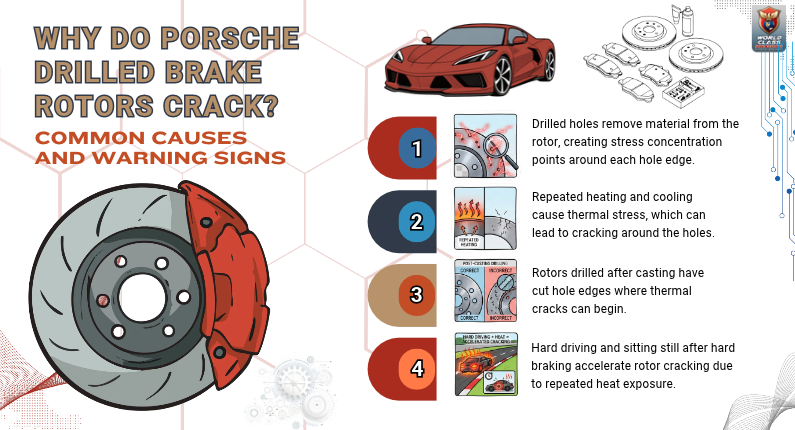
The holes exist to vent gas and water off the pad face and to shed a little weight. They also remove material, and each hole edge becomes a stress concentration point in a part that goes from ambient to several hundred degrees and back again, repeatedly.
A rotor that is cast with the holes formed in the mold has a denser, smoother hole wall. A rotor that is cast solid and then drilled afterward has a cut edge, and that edge is where thermal cracking starts. Many quality rotors are drilled after casting and then chamfered to relieve the edge, which helps considerably.
Hard use accelerates all of it. So does a hard stop followed by sitting still with hot brakes, and that is why the worst cracking tends to appear on cars used for short aggressive runs instead of long steady ones.
The lines that matter and the lines that do not
Acceptable, with monitoring: short hairlines running between two adjacent holes, staying within the pad sweep area, not opening up under a fingernail. These are extremely common, they stabilize, and the rotor continues to work.
Not acceptable: any crack that reaches the outer circumference of the rotor, any crack that runs toward the hub or the vane area, a crack wide enough to catch a fingernail, or multiple cracks joining into a network. Any of those means the rotor comes off the car.
Also not acceptable, and easy to miss: a hole that has begun to elongate or a chunk lifted out of the friction surface near a hole. Both count as material loss, and either one will chew through a set of pads.
What gets measured before anything gets replaced
Thickness, with a micrometer, at six or eight points around the disc, compared against the minimum stamped on the rotor hat. Lateral runout, with a dial indicator against the rotor face with the wheel off. Then a visual check of both faces with the rotor clean, because brake dust fills hairlines and hides them.
That takes a few minutes and it converts an argument into a number. A rotor that is 2 millimeters above minimum with two short hairlines is a different proposition from one sitting at minimum with the same cracks. Where a state still runs a safety inspection, it writes the thresholds as numbers too. Pennsylvania’s vehicle code tells an inspector to reject a car when the drums or rotors are scored deeper than .015 inch, or when disc thickness falls under the minimum stamped on the assembly. A measurement clears a line like that or it does not.
Replacement costs are not what they were
Nobody enjoys this conversation. Brake parts for a performance car sit at the expensive end of the catalog, and a rotor set is not something anybody should be buying on a hunch.
What that argues for is measuring instead of assuming, and replacing in proper pairs instead of chasing a problem one corner at a time. It also argues for pad selection that suits how the car is actually driven. A track-oriented pad on a car that mostly runs Glades Road puts heat into a rotor that never gets a chance to use it.
A note on carbon ceramic discs
Porsche Ceramic Composite Brakes are a separate subject. They do not crack the way cast iron does, they are judged on weight loss and surface condition instead of thickness alone, and the assessment procedure is specific to the system. If your car has the yellow calipers, the inspection is different and the replacement cost is in a different league entirely. Bring it in rather than reading across from an iron rotor article, including this one.
Frequently Asked Questions
Q: Can cracked drilled rotors be resurfaced?
A: No. Turning a drilled rotor removes thickness it cannot spare and does nothing about cracks that run below the surface. Drilled rotors are replaced, not machined.
Q: Are slotted rotors better than drilled for a street Porsche?
A: Slots avoid hole-edge cracking and still clear gas and water off the pad. Many owners who have cracked a set of drilled rotors move to slotted and are happy. Choosing slots is a preference and not a correction.
Q: How often should Porsche brake fluid be changed?
A: Follow the interval in your maintenance schedule. Fluid absorbs moisture over time, and on a car with real braking capability a boiling point that has drifted downward is a worse problem than a hairline crack.
Bring It In and Let Us Measure the Rotors
A photo through the spokes cannot settle this. Ten minutes with a micrometer and a dial indicator can.
World Class Auto Repairs, 9787 Glades Rd, Boca Raton, FL 33434. More at worldclassautorepaircenter.com.